Recent Purchase
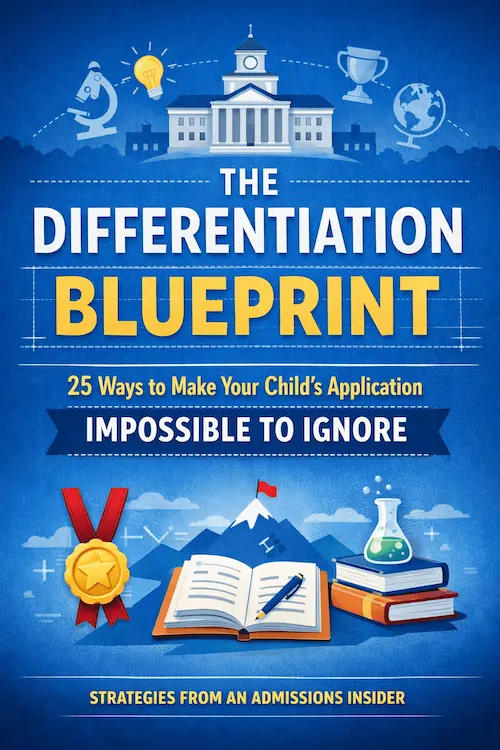
The Differentiation Blueprint™
MIT Admissions Insider Intelligence

Your Child Works Too Hard to Lose on Positioning

25 proven strategies that transform "strong student" into the applicant top schools fight over, from an MIT interviewer who's seen both sides.

  • Your child has the GPA and test scores, but so does every other applicant
  • You're watching families spend $15,000 on consultants and wondering if you're falling behind
  • Summer is approaching and you're not sure if your child is building the right things
  • You keep hearing about "differentiation" but have no idea if your child actually has it
  • Deep down, you have no objective way to know if your child is truly competitive
★★★★★ 4.9/5 from verified families 300+ families advised 100+ Essays & Applications Reviewed
Instant Digital Access

Get Your Blueprint for $37

The Differentiation Blueprint™
  • 143-page PDF, instant download
  • 15+ worksheets & templates
  • 30/60/90-day action plans
  • 25 proven strategies
Get the 25 Strategies for $37 →
We respect your privacy. No spam, ever.
30-Day Money-Back Guarantee. Not valuable? Email me for a full refund. No questions asked.
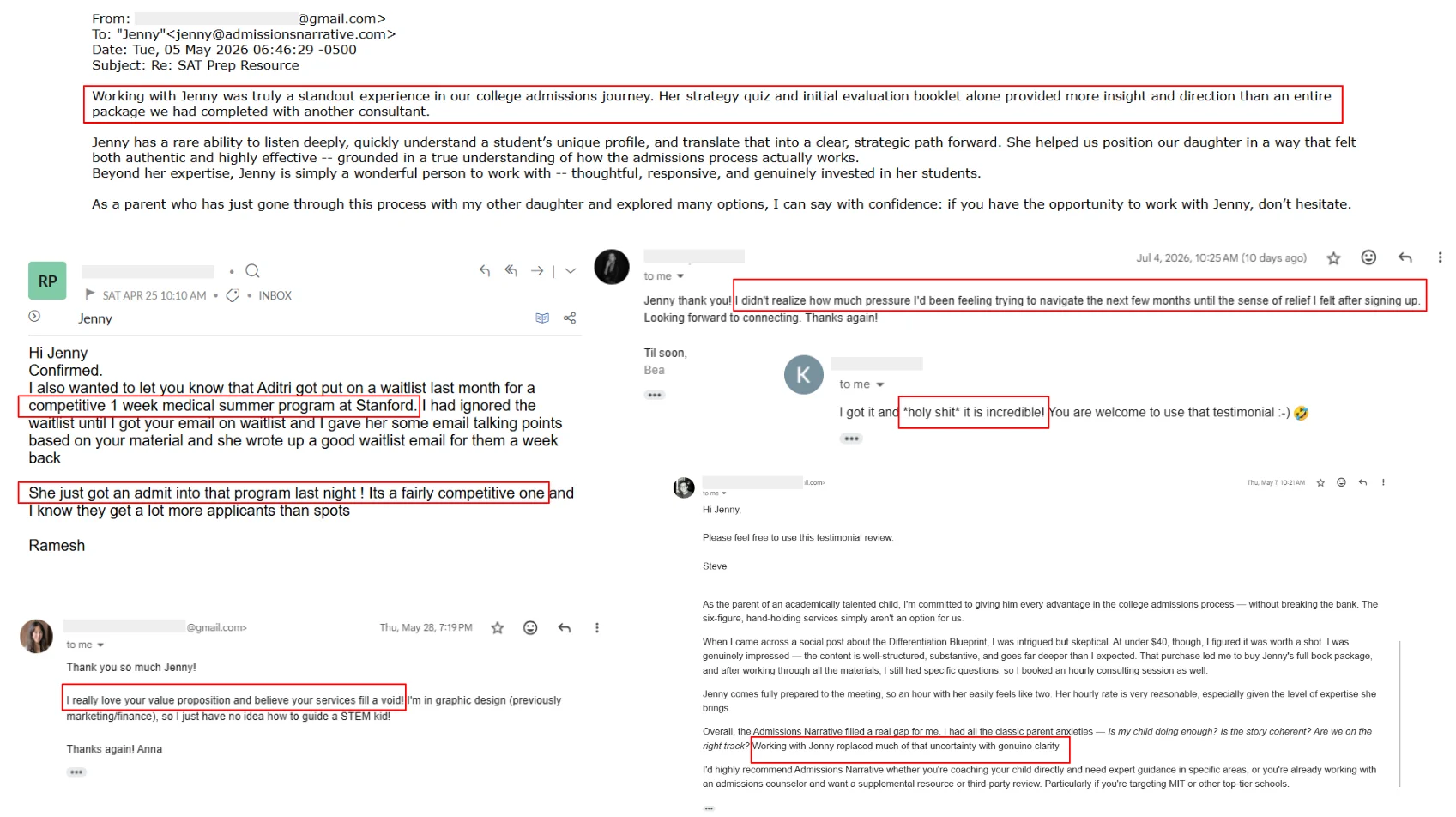
In Parents' Own Words

Our Students Got Into

89%
of applicants are academically qualified, yet only 4 to 6% get in
100+
essays & applications reviewed
$37
vs. $5,000 to $15,000 for a private admissions consultant

Your child isn't competing against "good students." They're competing against 35,000+ applicants who also have great GPAs.

At MIT, Stanford, and the Ivies, academic qualifications are a baseline, not a differentiator. What separates the accepted from the rejected is strategic positioning. Most families never figure this out until the rejection letters arrive.

✗What families assume matters
  • A 4.0 GPA makes them competitive
  • Taking 5 APs shows rigor
  • Being president of a club shows leadership
  • Starting a nonprofit = automatic differentiation
  • A strong essay can fix weak positioning
  • More activities = stronger application
✓What admissions officers actually see
  • Is this rigor impressive for their school context?
  • Does their activity list show authentic intellectual vitality, or resume padding?
  • Are they differentiated in their intended major's applicant pool?
  • Is there a clear, memorable narrative threading through everything?
  • Does this student have a genuine "spike," or are they just well-rounded?
  • What is this student's unique contribution to our community?
700+
Other applicants have the exact same profile as your child right now. Grades alone will not get them in.
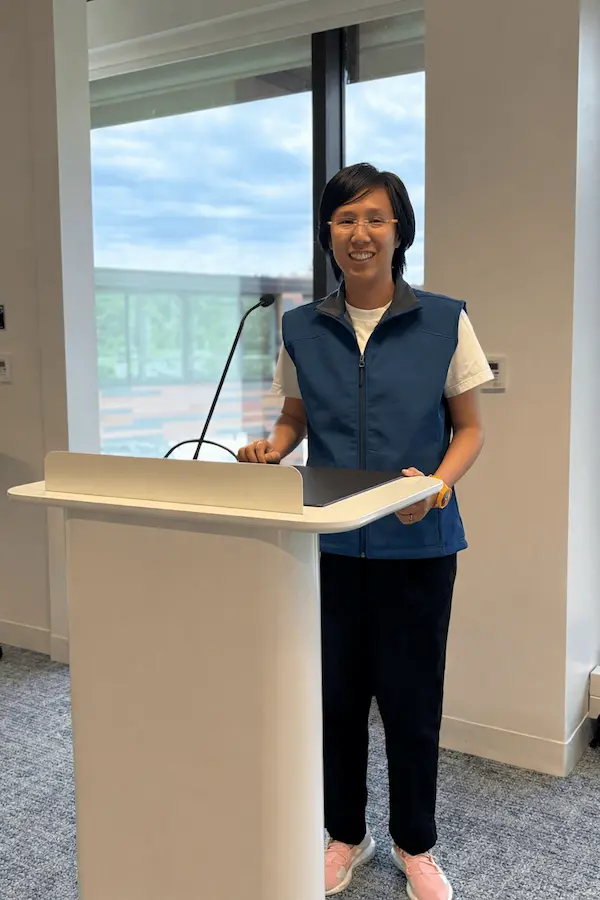
Jenny
MIT Class of 2008 Brain & Cognitive Sciences MIT Interviewer 2008 to 2021 300 Families Advised

I've been on every side of elite admissions, and I've seen what actually works

"Most families have no idea how admissions officers evaluate their children, until it's too late to fix the gaps."

My name is Jenny. In 2004, as a student from a modest-income family, I was admitted to MIT on a full financial aid package. Today, after 10+ years conducting admissions interviews for MIT as an MIT Educational Counselor, I help families understand exactly what MIT, and schools like it, are looking for. I've seen the rubrics. I've watched brilliant students get rejected for entirely fixable positioning errors.

Two years ago, I watched a church friend's daughter (4.0 GPA, 1580 SAT, president of two clubs) get rejected from every Ivy she applied to. She had the credentials but not the differentiation. The activities but not the narrative. The grades but not the "spike."

That's when I built the Blueprint: a complete system to give every family the insider intelligence that only well-connected families or $15,000 consultants usually access.

300families advised
100+Essays & Applications Reviewed
$10k+saved vs consultants

A complete system, not generic college prep advice

Every strategy is organized inside the 5-Pillar Differentiation System™, the framework for what actually makes an application memorable. Each one includes what it is, how to do it, real student examples, why it works, common mistakes, and a realistic timeline. 25 strategies, 5 pillars, one clear roadmap.

01
Academic Signal
Rigor and traction in key subjects that create intellectual credibility, not just "I took APs."
02
Intellectual Vitality
Curiosity that produces tangible artifacts, not just "I'm passionate about X."
03
Impact & Leadership
Evidence your child moves things forward and creates measurable change, not just title-holding.
04
Character & Contribution
How they treat people and serve others: the "Turning the Tide" factor most families ignore.
05
Narrative Coherence
A story that snaps into focus, where everything connects to a central theme admissions officers remember.
25
Proven Strategies
One for every gap a competitive application can have. Choose the 5 to 8 that fit your child's natural strengths.
✓
143-page Blueprint PDF with instant download
✓
15+ worksheets and templates you can use today
✓
30/60/90-day implementation plans with daily actions
✓
Real examples from MIT, Stanford, Harvard, Yale, Princeton admits
✓
Before/after rewrites showing exactly how to fix weak positioning
✓
Parent guardrails: help without hijacking your child's authenticity
✓
Differentiation Self-Assessment Worksheet
✓
5-Pillar Profile Audit Worksheet with pillar-by-pillar scoring

Real results from real parents

These are stories from families who used specific Blueprint strategies, not generic praise.

★★★★★
"The Blueprint gave us specific, actionable strategies we could implement immediately. Within 60 days, her profile was completely transformed. Worth 10x what we paid."
Miguel T. ✓ Verified
Parent of MIT Class of 2028
★★★★★
"Seeing real examples of how other students transformed their profiles made everything click. We used Strategy #12 (measurable impact language) to rewrite all of our son's activity descriptions. The difference was night and day. His activities went from generic to compelling."
Beth L. ✓ Verified
Parent of Yale Class of 2028
★★★★★
"I'm an overinvolved parent. I admit it. The guardrails section helped me understand where I was helping vs. where I was hurting. I backed off, let my daughter own the process, and her authenticity improved dramatically. The admissions officers could tell."
Sarah M. ✓ Verified
Parent of Princeton Class of 2028
★★★★★
"I was terrified we'd get the Blueprint and not know where to start. The 30-day plan told us exactly what to do first. We followed it step-by-step and saw immediate results. By day 30, we had real momentum."
Jennifer K. ✓ Verified
Parent of Stanford Class of 2028

What makes this different from generic college prep books

Generic college prep advice says…
"Take challenging courses," but which ones? How many? In what sequence?
"Show leadership," but what kind? What makes it real vs hollow?
"Be authentic," but how do you make authenticity memorable to a stranger reading 40 apps a day?
"Start a nonprofit," even when it's obviously manufactured for applications
Generic advice that applies to every student regardless of their situation
The Differentiation Blueprint gives you…
25 specific strategies with step-by-step implementation for your child's actual situation
Real before/after examples showing exactly how to transform weak positioning into strong
The 5-Pillar Differentiation System™, including the 5-Pillar Audit, to identify exactly which gaps are limiting your child right now
30/60/90-day plans so you know precisely what to do first, second, and third
Insider reasoning: why each strategy works, backed by actual admissions office logic

Right now you're in the golden window

Every month that passes is a month of positioning your child never gets back. Strategic families don't wait for a "good time" on the calendar to identify gaps, optimize activities, and build a differentiation narrative before essay season arrives. They start as soon as they realize what's actually being evaluated. The students who get in don't wait for a signal to start. They start now.

✓ Identify competitive gaps early ✓ Optimize summer plans now ✓ Build your narrative before essays ✓ Course-correct before it's too late
Positioning compounds. Waiting doesn't reset it.

Selective program applications, activity commitments, and recommendation-letter relationships all get locked in well before senior year essays are ever written. A student who starts positioning even one year earlier carries a full year more runway than one who waits. This isn't a countdown timer. It's how the admissions calendar actually works, no matter when you're reading this.

A real look at what you're getting

Here's a preview of three sections that families tell us changed how they see the entire process.

The 4 types of applicants: which one is your child?
Type 1: The Credential Collector
High GPA, long list of titles and activities. No depth, no clear passion, everything feels manufactured.
Usually rejected
Type 2: The Scattered Achiever
Good at many things, involved in everything, no clear focus. No narrative, no memorable identity.
Waitlisted or rejected
Type 3: The Authentic Specialist
Clear intellectual passion, deep engagement, measurable impact. Sometimes weaker stats than Types 1–2.
Usually accepted
Type 4: The Complete Package
Strong stats plus clear differentiation plus authentic narrative. The Blueprint is designed to get your child here.
Accepted, often with scholarships
Before/after: what one strategy actually changes
Strategy 12: Measurable Impact Language. Takes 1–2 weeks. Changes every activity description in the application.
Before
"Volunteered at hospital."
"President of Environmental Club."
"Tutored students in math."
After
"Created patient check-in guide; reduced missed forms by 30% across 6 shifts."
"Led 15-member team to implement school-wide composting; diverted 2,000+ lbs of waste in one semester."
"Tutored 12 students in Algebra II; 10 improved grades by a full letter, 11 passed the final."
If you only do 4 strategies, do these
The full Blueprint has 25. These four move the needle fastest for most families.
  1. Measurable Impact Language Transforms existing activities without adding new ones. An immediate win for any application. Rewrite every activity description using the formula: Action + Scope + Outcome. "Tutored students" becomes "Tutored 12 students in Algebra II; 10 improved by a full letter grade." This single reframe transforms a forgettable list into a compelling track record. No new activities required.
  2. Make Recommendations Easy Strengthens the letters that speak for your child when they're not in the room. Give each teacher a one-page "brag sheet" with 3 specific class moments, 2 traits with concrete examples, and 1 growth story, all before they start writing. Teachers want to write strong letters; they just don't always have the material. This strategy fills that gap and dramatically improves what gets said about your child when they're not in the room.
  3. Curiosity Stack Demonstrates the intellectual vitality that separates memorable applicants from forgettable ones. Document how one question led to another, at least 3 layers deep: Interest → Question → Investigation → Insight → Next Question. This is the difference between "I'm passionate about biology" (a claim) and a student who tested soil pH, mapped the findings, presented to the city environmental committee, and is now researching what policies actually work (proof). Elite schools want the second student.
  4. Three-Word Brand Creates coherence across the entire application. Once you have it, every decision becomes clearer. Three words that capture your child's unique identity, used internally to guide every application decision. Examples: "data-driven caregiver," "community-first builder," "curious technical teacher." When you have this, you instantly know what essays to write, which activities to cut, and what "Why Us" paragraphs should say.

All 25 strategies, 15+ worksheets, and 30/60/90-day plans. $37, instant download.

Get instant access →
Bonus · Buy Today
Order today and the Blueprint grows from 25 strategies to 34.

Bonus Chapter: From Blueprint to Application

Strong students lose ground at the last step. They have real work, real leadership, and a coherent record, then flatten it into "Member. Attended meetings." or spend 650 words of the personal statement retelling activity #1. Differentiation at the senior stage is not invention. It is translation. This 23-page bonus chapter shows your child how to make the work they already did visible in the few fields the Common App gives them.

  • Build the activities list from proof, not memoryStart from your pillar audit so paid work, family duties, and quiet projects make the cut.
  • Master the 150-character mathTurn each activity into a tight proof statement with no wasted words.
  • Order it like a highlight reelPut the strongest pattern in the first slots, not the last.
  • Find the missing dimensionChoose a personal statement topic by asking what the reader still cannot see, not what sounds most impressive.
  • Match the story to the promptPick the story first, then the Common App prompt that fits it. Includes a prompt map.
  • Write the moment, not the resumeUse the Zoom-Level Ladder to get from generic summary to a scene with a voice.
  • Run the Coherence Cross-CheckGive every fact one job across the activities list, essay, Additional Info, and Challenges sections.
  • Keep your authentic voice in the AI eraUse AI, editors, and parents to sharpen the thinking without replacing the student's authorship.
  • Pass the Swap Test on supplementsMake every school-specific response impossible to send to another college with just the name changed.

Also inside: a strategy-by-strategy translation map showing where each of the original 25 strategies belongs on the application, current 2026-2027 Common App limits, and a 60-minute final polish plan for the week before submission.

Included free with today's order. No extra checkout, no add-on to select. Same $37, same instant download.

Get the Blueprint + Bonus →

One payment. Lifetime access. Zero risk.

The Differentiation Blueprint™
$37
One-time payment  ·  Instant download  ·  No subscription
  • Private admissions consultant$5,000 to $15,000
  • Activity positioning workshop$300 to $800
  • Essay strategy consulting (per session)$500 to $2,000
  • Profile optimization guidance$1,000 to $3,000
  • The Differentiation Blueprint™ $37
Buy today and get the Bonus Chapter free: 9 additional strategies (26 to 34) that turn your child's differentiation work into a stronger activities list, personal statement, and supplements.
Get the 25 Strategies for $37 →
30-Day Money-Back Guarantee. If you don't find the Blueprint insightful and actionable, email me for a full refund. I've never had to issue one, but the guarantee is unconditional.

Everything you need to know

No. This is the exact playbook I've used with 300 families. Every strategy includes real examples from students who got into MIT, Stanford, Harvard, Yale, and Princeton. It's insider intelligence, not recycled advice from a book published 10 years ago.
Yes. The 25 strategies are designed to be flexible and adaptable. You don't implement all 25. You use the 5-Pillar Differentiation System's Audit to identify which gaps apply to your child, then choose the 5 to 8 strategies that fit their natural strengths and interests. The fast-start plans help you prioritize from day one.
Yes. Many strong applicants don't have one dramatic talent. The goal is depth and a coherent story, and that can be two or three related areas rather than one trophy. The Blueprint's Audit helps you find the thread that's already there, so you aren't forcing a passion your child doesn't have.
Yes. Many of the parents I work with didn't grow up with the American admissions system, and this is written for them as much as it is for American parents. Every strategy is explained step by step with real examples, so you don't need an insider's background.
Perfect timing. Sophomores have the most runway to implement these strategies meaningfully. You can build differentiation over 18+ months instead of scrambling in senior year. The earlier you identify gaps, the more options you have to address them authentically.
It's not too early to plan, only too early to perform. In 7th and 8th grade the goal isn't a resume, it's exploring interests so your child chooses activities on purpose by 9th grade. Starting early usually lowers pressure because nothing is rushed. You can read the Blueprint now and use it as your map for the years ahead.
The Blueprint is designed to work with your existing commitments. You're not adding 25 new activities. You're optimizing and reframing what your child is already doing. Most strategies involve strategic repositioning, not new obligations.
If for any reason you don't find the Blueprint valuable, simply email me and I'll refund you in full within 30 days. No forms, no questions, no hassle. I've never had to issue a refund, but I offer the guarantee unconditionally.
A private consultant charges $5,000 to $15,000 and the quality varies wildly. The Blueprint gives you the same strategic intelligence I'd share in a consulting engagement (the frameworks, the worksheets, the before/after examples) at 1/100th of the cost.
Many families are pitched five-figure programs before they know what they actually need. The Blueprint is a $37 way to get the strategy first. Then you'll know exactly what to ask a consultant, or whether you need one at all.
Read it yourself first. It's written for parents, so you can pick one or two ideas that fit what your child already cares about and share those, rather than handing over 25 strategies. It lands better when it's tied to their goals than when it feels like parental pressure.
This isn't for families looking for a shortcut that skips the actual work, or for students who aren't willing to be authentically involved in shaping their own narrative. The Blueprint gives you the strategy. Your child still has to do the work of living it.

Your child has worked too hard to lose on strategy

Six months from now, one of two things will be true: either your child's application looks like every other 4.0-GPA, well-rounded applicant in the pile, or it has a clear, memorable throughline an admissions officer reading 40 files a day actually remembers. The difference isn't your child's potential. It's whether someone helped you see the gaps while there was still time to close them. That's what $37 buys you today.

Get the 25 Strategies for $37 →
30-day money-back guarantee  ·  Instant download  ·  No subscription